
If you follow the headlines, you've heard the housing market described as everything from "cooling" to "crashing" this year. As usual, the truth depends entirely on which market you're actually

Dated: May 20 2026
Views: 222
I moved to Wilmington in 2002.
Military Cutoff was a two-lane road back then. There was no Mayfaire Town Center. There wasn't much of anything along that stretch — some pine trees, a few older properties, and a quiet drive out to Wrightsville Beach. Landfall was still relatively new and felt like it was sitting out in the country. Wrightsville Beach home prices hadn't gone vertical yet. Wilmington itself still felt like a small coastal town that most of the rest of the state didn't really think about.
Twenty-four years later, the stretch of Military Cutoff between Mayfaire Town Center and Wrightsville Beach — what a lot of people in town now call the Golden Mile — is one of the most affluent corridors in the city. Mayfaire turned a wooded tract into the dominant shopping and dining ecosystem on this side of town. Landfall became one of the premier addresses in Wilmington. Wrightsville Beach prices, well — anyone who's been here a while doesn't need me to explain what happened there.
And right now, in 2026, the Golden Mile is going through its next chapter.
This isn't speculation. It's not a forecast. It's a status report on what's already in motion — and why buyers and owners who understand it now will be in a fundamentally different position than the ones who notice when the ribbons get cut.
Four things are converging at the same node, and the combination is what makes this moment different from the last decade of "Wilmington is growing" talk.
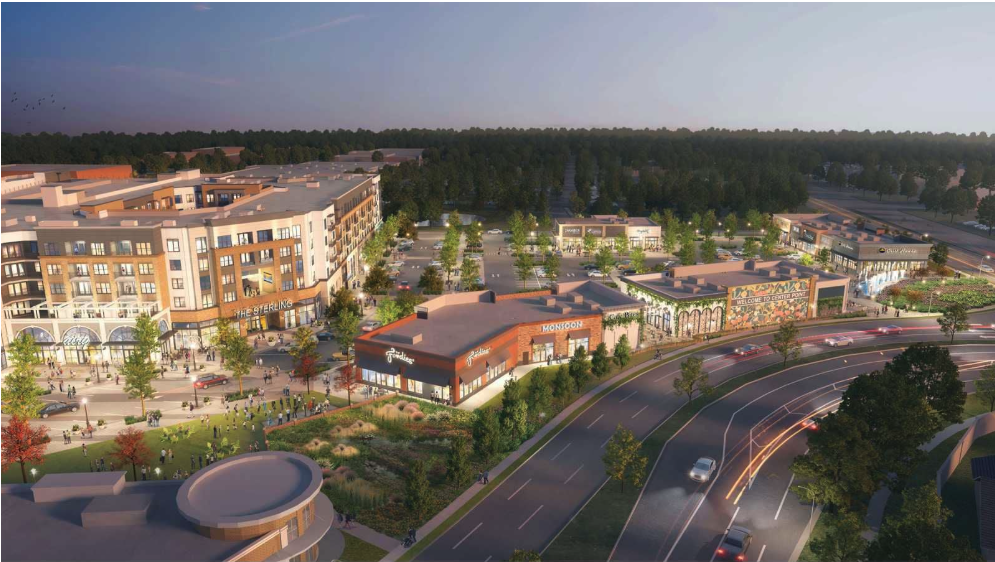
Center Point is vertical. The 23-acre mixed-use development at Eastwood and Military Cutoff — a joint venture between The Beach Company, Swain & Associates, and Larson Capital Management — is no longer a rendering. It's a construction site with visible structure. The Sterling, the 265-unit luxury apartment phase inside Center Point, is expected to open in August 2026, with pre-leasing starting in May. Behind it: a curated mix of retail and dining (about 80% of the retail space is already pre-leased), restaurant space, office, and a planned hotel. First retail openings are projected for winter 2026 through early 2027. This is the largest single piece moving on the corridor.
Drysdale Drive Extension is open. This is the connector between Military Cutoff and Eastwood Road that quietly does more for daily life in this corridor than most people realize. It cuts the pressure on the Eastwood/Military Cutoff intersection, opens a new way in and out of Center Point, and gives Eastport, Landfall, and Mayfaire-bound traffic a real alternative. If you haven't driven it yet, drive it. The corridor already feels different.
The Avenue is still planned at 349 Military Cutoff. Forty-four acres. A 234-room Westin hotel and spa. Over 500 residential units. Retail and restaurant space pitched at the high end of the Wilmington market. The Carroll Companies cleared the site in late 2024 and continues to move it through the city's process — the total investment is now estimated at around $300 million. When this one finally goes vertical, the Mayfaire end of the corridor gets a second anchor.
The NCDOT overpass is advancing — but slower and more contested than the original timeline. The U-5710 project — a grade-separated interchange that takes Eastwood Road over Military Cutoff — has been on NCDOT's radar since 2014, with the last public meeting held back in 2018. NCDOT's most recent timeline puts the project out to bid in September 2027 with an approximately four-year construction phase. Meanwhile, opposition has organized — the Wrightsville Beach Chamber of Commerce, Wilmington Mayor Bill Saffo, and the Wilmington City Council have all formally asked NCDOT to revisit the design or delay the project until the Wrightsville Beach bridge replacements are further along. As of early 2026, NCDOT has stated it is not postponing U-5710. NCDOT also projects this corridor going from roughly 75,000 daily vehicles today to over 100,000 by 2045. Whichever way the politics break, the broader point is the same: the road network is being forced to catch up to demand that's already here.
Any one of these on its own would be a notable story. Stacked together, on the same mile, in the same delivery window, they create something different: a corridor that is being rebuilt while it's being lived in.
Why this matters for buyers and owners right now
I have this conversation a lot. Someone is looking at a home in Landfall, or near Mayfaire, or off Eastwood, and they ask the reasonable question: "Is this a good time, or should I wait?"
The honest answer is that the Golden Mile is in the window where the market hasn't fully repriced for what's coming. That window is real, but it isn't permanent. Here's how I think about it.
When a corridor like this matures, value moves through three phases. First is the speculation phase — everything is on paper, nobody can see anything, and most buyers discount the plans because Wilmington has a long history of projects that get announced and never break ground. Second is the delivery phase — construction is visible, residents and tenants start arriving, traffic patterns shift, and the corridor starts to feel different. Third is the maturity phase — the ribbon is cut, the hotel is open, the apartments are leased, the retail is humming. Pricing in the maturity phase reflects everything the corridor became.
The Golden Mile is somewhere in the middle of phase two right now. That's not a coincidence. That's the moment when buyers who pay attention have an advantage and buyers who wait for confirmation pay for everyone else's confirmation.
I've watched this exact cycle play out before — on this exact road. The buyers who got into Landfall before Mayfaire was built, or who bought near Wrightsville Beach when prices still made sense, weren't lucky. They were paying attention. The mechanics of the next chapter are the same.
The lifestyle case, separate from the development case
I want to make a point that often gets lost in the spreadsheet version of this story. The reason the Golden Mile has held value for two decades, and the reason it will continue to hold value after all the cranes come down, is not the development. It's the location.
You are minutes from Wrightsville Beach. You are inside the Mayfaire shopping and dining ecosystem. You are connected to Landfall and Wrightsville's drawbridge. You have grocery, healthcare, schools, and the boat ramps within a short drive. The corridor sits at the intersection of everyday convenience and coastal lifestyle, and that combination is genuinely rare on this stretch of the North Carolina coast.
The new development is amplifying something that was already true. It is not creating value out of nothing.
What I'd watch over the next twelve to eighteen months
If you want concrete signals to track, here's what tells you which way the corridor is moving.
The Sterling's pre-leasing traction in mid-2026 will tell you what the market is willing to pay for new luxury rental product in this node, and that pricing will set a floor for what new for-sale product can ask. Center Point's first retail and restaurant openings — projected for winter 2026 through early 2027 — will tell you which brands have decided the Golden Mile is worth their investment, and brand selection is one of the cleanest leading indicators of corridor positioning. The Avenue's progress through technical review and any vertical movement on site will reset expectations for the Mayfaire end of the corridor. U-5710's path to the September 2027 bid date — whether NCDOT proceeds as planned or opposition succeeds in delaying the project — will affect traffic, sentiment, and timeline assumptions across the entire corridor. And finally, watch for hospitality announcements. Hotels follow demand. They don't create it. When you see the next hotel commitment, you're seeing a sophisticated operator's bet on this corridor.
Where this leaves you
If you're already on the Golden Mile, the next twenty-four months are going to be noisy. Construction trucks. Detours. New neighbors. The honest read is that the noise is the price of the repricing, and the repricing is happening whether you participate in it or not.
If you're considering buying in or near the corridor, the framework I'd use is simple: don't try to time the bottom, because there isn't one to time. Try to enter before the maturity phase prices in everything that's still being built. That window is open right now. It will not stay open indefinitely.
And if you're considering selling, please don't underprice. The temptation when a corridor is mid-construction is to discount for the disruption. The better read is that you are selling into a corridor that is being permanently upgraded, and the buyer pool that understands what's coming is willing to recognize that.
The bottom line
When I drove down Military Cutoff in 2002, I could not have told you what it would look like in 2026. Most of us couldn't have. The people who happened to buy along this corridor in those early years didn't have a crystal ball — they had a feel for where the city was heading and they were willing to plant their flag before the rest of the market agreed with them.
The Golden Mile is going through that exact moment again. It's a different decade, a different generation of projects, but the dynamic is identical. A corridor in transition. A market that hasn't fully repriced yet. A short window between "you can see what's coming" and "everyone else can see it too."
If you want to walk this corridor with someone who's been here long enough to recognize the pattern, I'd love to talk.
Ben Eisenberg,
Broker/REALTOR®
#1 RE/MAX Agent in Wilmington
2023, 2024, 2025
910.619.1533 Ben@BenEisenbergGroup.com · BenEisenbergGroup.com
If you follow the headlines, you've heard the housing market described as everything from "cooling" to "crashing" this year. As usual, the truth depends entirely on which market you're actually
Memorial Day weekend wraps up. The Wrightsville Beach traffic was bumper-to-bumper Saturday morning. The boats were out. The first real sunburn of the season showed up at the office on Tuesday.And
A little local historyI moved to Wilmington in 2002.Military Cutoff was a two-lane road back then. There was no Mayfaire Town Center. There wasn't much of anything along that stretch — some
UNC Health just announced plans for a new hospital at South 17th Street and Shipyard Boulevard in Wilmington, targeting a 2030 opening — and it's going to move the real estate market in a
 All information deemed reliable but not guaranteed. All properties are subject to prior sale, change or withdrawal. Neither listing broker(s) or information provider(s) shall be responsible for any typographical errors, misinformation, misprints and shall be held totally harmless. Listing(s) information is provided for consumer's personal, non-commercial use and may not be used for any purpose other than to identify prospective properties consumers may be interested in purchasing. The data relating
to real estate for sale on this website comes in part from the Internet Data Exchange program of the Multiple Listing Service. Real estate listings held by brokerage firms other than Ben Eisenberg Group may be marked with the Internet Data Exchange logo and detailed information about those properties will include the name of the listing broker(s) when required by the MLS. Copyright ©2026 All rights reserved.
Last Updated: September 23, 2026 6:15 AM UTC
Show More...
All information deemed reliable but not guaranteed. All properties are subject to prior sale, change or withdrawal. Neither listing broker(s) or information provider(s) shall be responsible for any typographical errors, misinformation, misprints and shall be held totally harmless. Listing(s) information is provided for consumer's personal, non-commercial use and may not be used for any purpose other than to identify prospective properties consumers may be interested in purchasing. The data relating
to real estate for sale on this website comes in part from the Internet Data Exchange program of the Multiple Listing Service. Real estate listings held by brokerage firms other than Ben Eisenberg Group may be marked with the Internet Data Exchange logo and detailed information about those properties will include the name of the listing broker(s) when required by the MLS. Copyright ©2026 All rights reserved.
Last Updated: September 23, 2026 6:15 AM UTC
Show More...
